

One Year Post Graduate Course in TV with specialization in Sound Recording and Television Engineering
The Course exposes students to various technical and aesthetic
aspects of Sound, enabling them to create effective soundscapes.
It is a compact combination of operational techniques and creative
abilities in the students. The Sound Department is equipped with
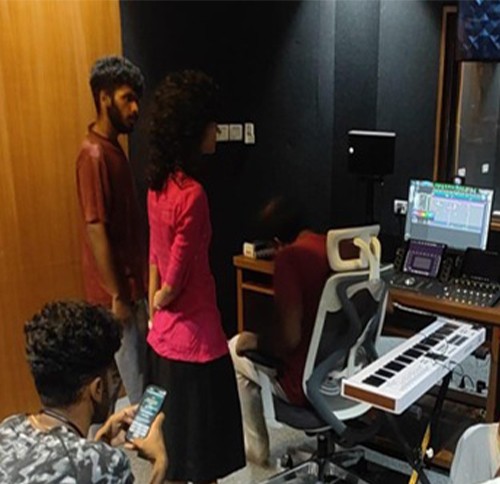
the Digital Audio Workstation, digital consoles, digital
recorders, professional boom and wireless microphones etc.
During the course students learn to record sound for Fiction and
Non Fiction programs. This basically comprises of Location Sound
Recording with the Industry standard Wireless Microphones, Boom
Microphones and Digital Audio Recorders. Students also learn the
Audio Post production of these programs on world class Digital
Audio Workstation Pro-Tools. Multi-camera exercise is another
coordinated activity which enables students to understand various
aspects and challenges of Live Audio-Visual program.
After the successful completion of the course students will have
professional skills to work as a Sound Recordist for Fiction and
Non-Fiction programs. They will be in a position to work
independently as a Production Sound Mixer as well as a Sound
Designer and a Re- Recording Mixer for various platforms like TV,
Documentaries, OTT etc. They will also be in a position to handle
the Audio Post-production which includes Editing, Processing,
Mixing and Mastering of above mentioned programs on the Industry
standard DAW (Digital Audio Workstation) Pro-Tools.
Television Engineering input related to present day television
technology is also imparted for better understanding of technical
issues. There are two multicamera High Definition (HD) TV studios.
Both HD studios are equipped with motorized lighting systems with
DMX panel, 16 channel Audio Console/ Mixer, Digital Video
Switchers, Multilingual Character Generators, Computer Driven
Tele-promoters, Digital VTRs etc. TV Engineering Department is
instrumental in imparting training on multicamera setup in
familiarization as well as specialization module. The department
also imparts training to carry-out Electronic Field Production
setup so as to expand the understanding of multicamera technique
in the field beyond studios. The department also introduces latest
technologies to the students like Artificial Intelligence, Virtual
Production etc. and briefs about how film making can be
carried-out by taking assistance from these latest technologies.
The department. also imparts inputs on how digital post-production
pipeline works i.e from dumping of camera card footage on digital
platform for the usage of same by Editor, Sound Recordist,
Colourist etc. and finally storage of same in DCP, DPX, .mp4, .mov
etc. formats.
Working on above stated Sound and TV engineering equipment and
studios, gives students the confidence to take up professional
assignments. Interactions with the industry experts help them
understand the current techniques and conventions prevalent in the
field.
Structure: The course is divided into three carefully designed phases with a modular structure:
Phase 1: Introduction to various skill sets
This is a common module in which students of all disciplines are introduced to basics of writing, direction, cinematography, sound recording and design, editing as well as production, informed by an aesthetic approach. Theoretical input and hands-on training in single and multi-camera exercises coupled with faculty mentoring and feedback instill a strong foundation.
Phase 2: Specialization in Sound Recording and TV Engineering (Fiction and Non-fiction)
Students of Sound Recording and TV Engineering embark on their specialization. They undertake fiction and non-fiction programs (ranging in duration from 5 - 12 minutes). They work with cutting-edge equipment and explore innovative storytelling in collaboration with their peers from allied specializations. The focus is on refining their skills in Sound Recording through guided inputs by seasoned faculty, visiting experts and practical workshops by acclaimed filmmakers and industry practitioners.
Phase 3: The course – end exercise
Students undertake a 15-minute film that showcases professional execution and a distinct personal aesthetic. Guided by experienced faculty and industry experts, this phase enables students to handle aspects Sound Recording and gain valuable feedback from internal as well as external faculty.
Course Duration: 01 Year (Yearly pattern, Total marks = 1000)
Total No. of Seats: 11
Eligibility Criteria: Bachelors Degree or equivalent in any discipline
Faculty:Sound
- Vaibhav Gham, Associate Professor and HoD
- Issac Newton, Assistant Professor
- Atul Lanjudkar, Assistant Professor
Faculty:Television Engineering
- Sandeep Shahare, Professor and HoD
- Dr. Alwin Anuse, Associate Professor
- Dr. Ranjit Sadakale, Assistant Professor
- Dr. Rajendraprasad Pagare, Assistant Professor
- Yogesh Sonawane, Assistant Professor